Challenging Extreme Working Conditions – How To Select Wear-resistant Parts In High-silica Ore, High-temperature, And High-abrasion Environments?
When crushers process high-silica ores with a quartz content exceeding 20% for extended periods, operate in the high-temperature environment of the Middle Eastern desert with summer temperatures exceeding 50°C, or come into contact with corrosive slurries containing sulfides, the service life of ordinary wear-resistant parts often drops drastically from several months to just a few days. Globally, friction and wear cause economic losses of up to €210 billion annually.
As a manufacturer of crusher spare parts, we firmly believe that under extreme operating conditions, the correct selection of wear-resistant parts materials is not simply a matter of cost, but rather a key factor directly affecting the stable operation of the production line. This article, combining the latest failure analysis research and field application data, provides mining users with a scientific and practical guide to selecting crusher wear-resistant parts.
- Three major challenges in extreme working conditions
- Material Selection Guide for Different Working Conditions
- Extreme operating condition selection decision
- Installation and maintenance: Preventing premature failure of high-quality materials
- Supplier Audit: Material Reliability Verification Project
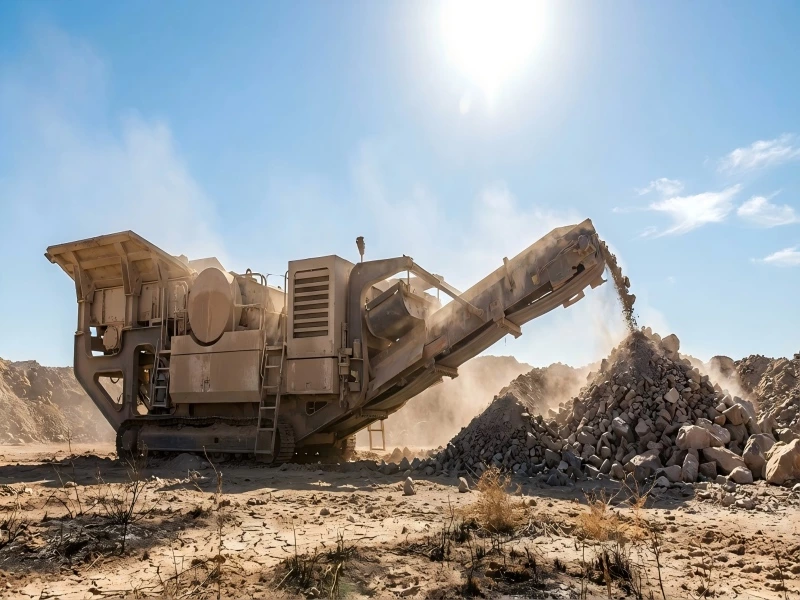
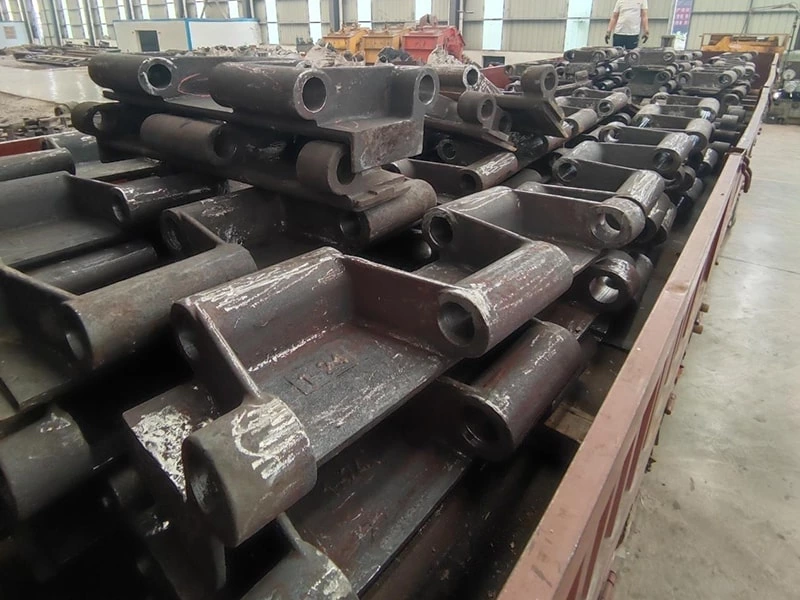
Crusher operating under high temperature and drought conditions
I. Three Major Challenges in Extreme Operating Conditions
1. High-silica ore: a natural "cutting tool"
When the quartz (SiO₂) content in the ore exceeds 20%, the abrasive environment will deteriorate significantly. Quartz has a Mohs hardness of 7, and its sharp particles act like countless micro-tools during the crushing process, causing continuous microscopic cutting on the surface of the liner.
Real-world examples show that in a diamond mine in Botswana, the lifespan of the cone crusher liner was shortened by 720 hours compared to the manufacturer's expectations when processing kimberlite containing diamonds and 40% quartz.
2. High-Temperature Environments: The Overlooked Hidden Killer
In the Middle East, including Saudi Arabia and the UAE, summer surface temperatures often exceed 50°C. The impact of high temperatures on wear-resistant parts is mainly reflected in two aspects:
- Material softening: Under continuous high temperature, the work-hardened layer of ordinary high-manganese steel is prone to temper softening;
- Thermal fatigue: The temperature difference between day and night causes repeated thermal expansion and contraction, which can easily induce the initiation and propagation of cracks in the lining plate.
3. Corrosive media: Accelerators of wear.
In wet crushing or sulfide-containing ores (such as chalcopyrite), corrosion and wear can create a synergistic destructive effect, where "1+1>2". Studies have shown that the wear rate of the same material in acidic media can be several times higher than in the dry state, and corrosion products penetrate along grain boundaries, further accelerating crack propagation.
II. Material Selection Guidelines for Different Working Conditions
2.1 High-silica ore working conditions: Hardness is the key factor
During the crushing process of high-silica ores (quartz content > 20%, compressive strength > 250 MPa), traditional materials that rely solely on work hardening are prone to failure, with failure modes mainly including abrasive wear, plastic deformation, and subsurface grain boundary cracks.
Recommended material:
- Mn18Cr2 or Mn22Cr2 high manganese steel: Adding 2%–4% chromium can form Cr₇C₃ chromium carbide, with a hardness of 1200–1600HV, forming a wear-resistant skeleton in the austenitic matrix;
- Ceramic composite materials: Al₂O₃ or TiC particles are embedded in high-manganese steel or high-chromium cast iron, and the service life can be 2.5–3 times that of traditional materials.
After upgrading the gyratory crusher liners from traditional aluminum bronze to a new type of aluminum alloy-based composite material, the service life of the crusher has increased by 2–3 times.
2.2 High-Temperature Environment Conditions: Thermal Stability is Key
In environments with sustained high temperatures, such as the Middle Eastern desert and steel slag processing, the thermal stability of materials is particularly important.
Recommended material:
- High-chromium cast iron: Chromium content 24%–26%, forming high-hardness M₇C₃ type carbides, excellent thermal stability, working surface hardness HRC 58–65;
- Gradient composite material: The surface is inlaid with nano-zirconia ceramic particles, which can work stably at high temperatures of 400–600℃.
Under high-temperature conditions, it is essential to ensure that the yield strength of the liner meets the requirements to avoid macroscopic plastic deformation.
2.3 High Impact + High Wear Combined Working Conditions: Bimetallic Composite Technology
Components such as semi-autogenous mill liners and large crusher liners often bear the impact of large pieces of ore and the grinding of highly abrasive minerals at the same time, and it is difficult to achieve both with a single material.
Recommended material:
- Bimetallic composite material: The working surface is made of high chromium cast iron (HRC 58–65), and the matrix is made of tough low alloy steel or manganese steel to achieve "hard outside and tough inside";
- Gradient composite wear-resistant liner: Metal-ceramic composite structure, which increases service life by 2-3 times and reduces overall operation and maintenance costs by more than 40% in the crushing of ultra-hard materials such as iron ore and copper ore.
III. Selection Decision under Extreme Operating Conditions
According to the material selection principles of the Wear-Resistant Materials and Castings Branch of the China Foundry Association, wear-resistant parts for extreme working conditions can be selected based on the following logic:
- Determine the type of working condition: High-silica ore / High-temperature environment
- High-silica ores are preferred:
- Mn18Cr2/Mn22Cr2
- Ceramic composite materials
- Bimetallic composite
- High-temperature environments are preferred:
- High-chromium cast iron (Cr26)
- Gradient composite materials
- Special heat-treated high manganese steel
- If there is high impact (feed particle size > 300mm or large particle rate > 30%), a bimetallic composite structure should be preferred; if there is no significant impact, a single material can meet the requirements.
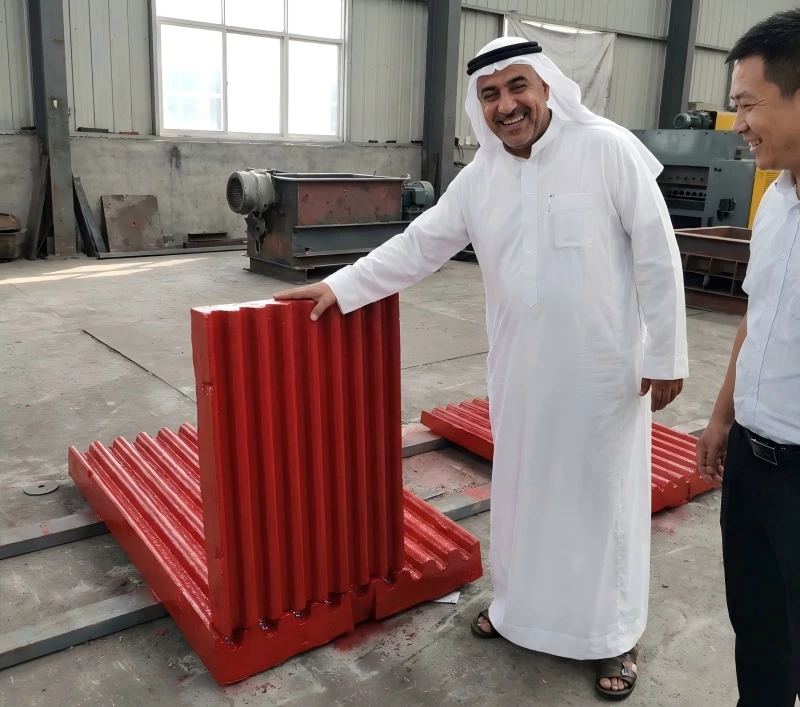
IV. Installation and Maintenance: Preventing Premature Failure of High-Quality Materials
4.1 Install temperature control
When casting the backing resin, if the temperature of the steel liner is below 15℃, the viscosity of the epoxy resin will increase, easily encapsulating air bubbles and forming "soft spots," which can easily lead to fatigue cracks under crushing loads. Recommendation: Preheat the liner and frame to 25–30℃ before casting.
4.2 Running-in period
After the new lining plate is installed, it is strictly forbidden to operate at full load immediately.
- 0–2 hours: Run the engine without load and monitor the oil temperature to ensure it remains stable;
- 2–4 hours: 50% feed rate, check for abnormal noises and loosening;
- 4–8 hours: 75% feed rate;
- After 8 hours: Gradually increase to full capacity.
4.3 Regular testing
Establish a preventative maintenance system:
- Weekly: Listen for unusual sounds; abnormal sounds may indicate looseness or cracks.
- Monthly: Vibration test; normal vibration value should be <1.8 mm/s.
- Quarterly: Measure the remaining thickness of the lining and record the wear trend.
V. Supplier Audit: Material Reliability Verification Project
When purchasing wear-resistant parts for extreme operating conditions, the manufacturer should be required to provide complete testing documentation. Specific requirements are as follows:
sheet
Testing items Requirements and standards Verification Objective Furnace Analysis Report P < 0.04%, S < 0.05% Control harmful elements to avoid brittleness and cracking. Metallographic analysis Fine-grained austenite with dispersed carbide distribution Verification of the rationality of heat treatment process and microstructure Hardness testing The hardness of the working surface meets the design requirements. Ensure stable wear resistance Ultrasonic flaw detection Key areas have no pores or looseness greater than 1mm Eliminate internal casting defects -
VI. Our Capabilities and Services
As a professional manufacturer of crusher spare parts, we can provide a full range of wear-resistant solutions for extreme working conditions:
- Material range: Mn13–Mn22 high manganese steel, Cr15–Cr26 high chromium cast iron, bimetallic composite, ceramic composite materials;
- Process support: resin sand casting, lost foam casting, centrifugal casting;
- Surface strengthening: laser cladding and hard alloy overlay can achieve a local hardness of HRC 65 or higher;
- Quality Assurance: Each batch is provided with spectral analysis, metallographic testing, ultrasonic flaw detection, and a complete quality report.
Conclusion
Under extreme operating conditions such as high silica, high temperature, and high abrasion, the selection of wear-resistant parts for crushers is a systematic engineering process, not a matter of experience. By accurately identifying ore characteristics, analyzing failure modes, matching appropriate materials, and standardizing installation and maintenance procedures, the lifespan of wear-resistant parts can be increased by 2–3 times, and the overall operating cost can be reduced by more than 40%.
For customized wear-resistant solutions, please provide the following working condition information, and we will provide you with a free material recommendation report:
- Ore type, quartz content, compressive strength
- Equipment model, feed particle size, crushing stage
- Operating environment temperature, whether it contains corrosive media
References
[ 1 ] China Foundry Association Wear-resistant Materials and Castings Branch. Selection and application of wear-resistant materials in mining [EB/OL]. https://naimo.foundry.org.cn/html/jishuzhishi279/304.html, 2021-06-18.
[2] Gao Jian. Innovative optimization of feed structure for non-ferrous metal coarse crusher based on reducing liner consumption [J]. World Nonferrous Metals, 2025(6): 46-48. https://opaj.napstic.cn/periodicalArticle/0120250601278893
[3] Newreg. The Work Hardening Threshold: Selecting the Correct Cone Crusher Parts for High-Silica Ores[EB/OL]. https://newregmachine.com/introduction-to-cone-crusher-parts-key-components-and-maintenance-guide/, 2025-07-14.
[4] China Foundry Association. Technical specifications for cast liners for autogenous and semi-autogenous mills: T/CFA 020102048 — 2022 [S/OL]. https://www.ttbz.org.cn/Home/Show/48293, 2022-11-30.
[5] Haitian Heavy Industry. Crusher Wear Part Optimization: The Complete Technical & Economic Guide for Mining & Aggregate Operations[EB/OL]. https://www.htwearparts.com/industry-news/, 2026-01-24.
[6] Adefila EO, Prasad RVS, Leso TP, et al. Failure analysis of mantle/head liner of a cone crusher at a diamond mine in botswana[J]. Engineering Failure Analysis, 2025, 109921. https://ouci.dntb.gov.ua/en/works/?backlinks_to=10.3390%2Fmin9070428